

Raised amid the dazzling white of the Apuan marble quarries, trained at the Academy of Fine Arts, and now performing on international stages from Milan to Seoul as an ambassador for the art of the body: body painter Maurizio Fruzzetti has turned his heritage into an art form. He transforms human skin into marble.
For Senjo Color, he gave us a rare glimpse into his work. He reveals how to master marble body painting, which mistakes immediately shatter the illusion, and why true expression only emerges when you stop trying to control everything.
London. A fashion show under the glaring spotlight. On stage stands a perfect marble statue—created entirely from paint on bare skin. But under the heat of the spotlights, the unexpected happens: the model’s blood pressure plummets.
It wasn’t a serious emergency, but the statue—which was supposed to remain motionless—began to waver right before everyone’s eyes. Body painter Maurizio Fruzzetti immediately stayed by her side, supporting her and keeping a close eye on her. And in doing so, he transformed her moment of weakness into the climax of the performance. He moved around her like a sculptor supporting a crumbling stone.
The result? The audience stopped seeing a mannequin and began to see a real person. A pivotal moment for Maurizio. “No matter how hard I try to turn the body to stone—life always has the last word.”
This instinct to let go of control and trust the moment has a root. But it isn’t in London.
That white has never left him
Maurizio grew up in the shadow of the Apuan Alps in Italy—with the dazzling, cold white of Carrara’s world-famous marble quarries always in view. This light shaped him even before he ever picked up a paintbrush.
As a child, the light reflected off the fractures seemed dense to him, almost sacred. “This absolute white taught me to seek out pure form and instilled in me an obsession with the three-dimensionality and grandeur of stone.”
This obsession ran through his entire artistic life—through painting, decoration, graphic art, and photography, and through his years at the Academy of Fine Arts, where he developed a language based on geometric forms and a schematic approach to form. But what actually happens when you transform human bodies into marble?
When he began specializing in marble-effect body painting in 2026, he did the opposite of what a traditional sculptor would do: “I no longer wanted to shape the material, but rather to transform human skin into marble. Through this interplay of light and dark, I try to breathe into my paintings the same sense of eternity that our mountains have preserved for millennia.”

When the Screen Suddenly Has a Heartbeat
In his early days as a body painter, the shift from the traditional canvas to the human body presented him with an unexpected challenge.
“In the past, on the canvas, I controlled every detail; with body painting, my canvas began to breathe. It was no longer a lifeless surface, but a body that moved and responded to my touch: I immediately realized that this discipline is a dialogue, not just painting.”
Despite years of experience in body painting, Maurizio had to re-learn, for his marble project, to follow the anatomy rather than impose his vision on it. And as he practiced, he made some glaring mistakes. At first, his sheer obsession with realism held him back.
“I was so obsessed with realism that I turned a model into a marble statue that was so gray and cold it looked like a mannequin. People passing by seriously asked how much it cost per piece.”
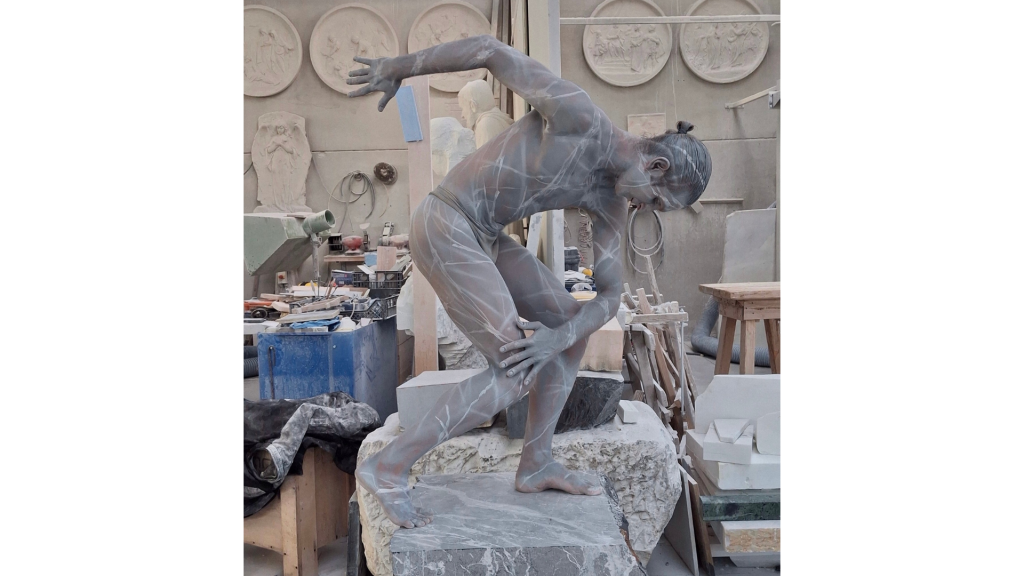
The challenge of marble-style body painting lies entirely in how light is handled. While other looks rely on bright colors, the marble style requires absolute mastery of light and dark: “You have to convince the viewer that the skin isn’t soft, but firm, heavy, and mineral-like. It’s a form of visual sculpture in which every shadow must add depth.”
To achieve this, Maurizio also had to learn to anticipate how the paint would react to the muscles and the heartbeat, and to transform movement into a means of expression. “Every vein I trace is a tribute to my homeland: my brush replaces the chisel, and for a moment, the skin becomes the most precious stone in the world.”
But it happens as it must. No sooner do you think you’ve got the hang of it than adverse set conditions come into play. “ I remember a situation where my model’s sweat—caused by the lighting on set—ruined a complex marble-vein pattern: The pattern, which had previously been clear and three-dimensional, turned into a shapeless smudge. Instead of panicking, I turned the mistake to my advantage: I blurred the softening edges, transforming the disaster into an effect reminiscent of stone eroded by time. The result looked older and more authentic than the original idea.”
From Skeptic to Artist
But in addition to the technical hurdles, there were also existential doubts. Maurizio often wondered if he was merely engaging in a nice stylistic exercise. Was he just a simple decorator who stripped people of their identity by turning them to stone?
“I feared that by transforming people into marble statues, I would ultimately deny their human nature, which consists of life and movement.”
Salvation came through the gaze of his models. When the work was done and they stepped in front of the mirror, something happened. They didn’t see themselves as painted, Maurizio explains, but as immortal—as elevated to a mythological dimension. In that moment, he understood:“I didn’t take away their humanity; I elevated it.”
At the same time, his understanding of control changed. The young Maurizio experienced art as a struggle. “ I tried to control everything—the color, the design, the result—convinced that perfection comes from an iron will. I was rigid and determined to prove who I was. “
He now knows that true strength lies in the art of letting go and in listening.
“Today, I no longer try to control form, but rather to understand it. My strength lies in experience: I have stopped fighting against the unexpected and have begun to see it as a treasure. I’ve come to understand that spiritual freedom doesn’t mean controlling everything, but rather staying present and ready to recognize beauty even when things don’t go as planned. “
The Artist’s Technique: How Skin Becomes Marble
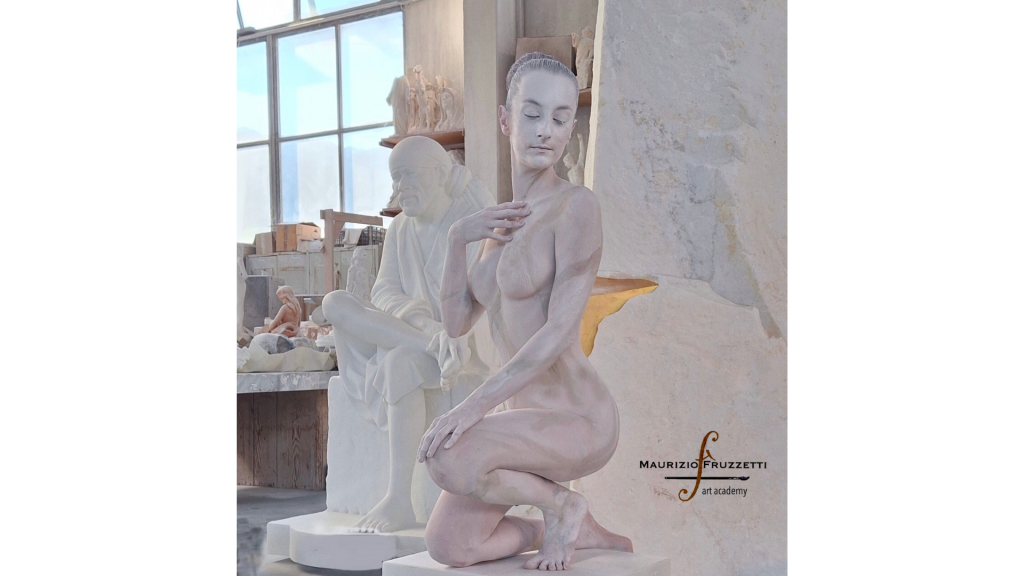
How does soft, warm skin come to look like heavy, cold mineral? It’s a matter of layers, pigment density, and the precise use of light and shadow.
- The right color: Maurizio works with highly saturated water-based pigments from Senjo Color’s Basic line, “which, when blended until transparent, create the sense of depth typical of veined stone.”
- The color palette: Work exclusively with neutral tones (white, gray, earth tones). The key professional tip: Use cool base tones for the shadows and warm tones for the veins. This prevents the overall result from looking dirty.
- The mattifying agent: Human skin reflects light. Stone does not. To perfect the optical illusion, setting agents and powder eliminate any natural reflection. The light is absorbed diffusely.
- Brush & Airbrush as a Duo: The fine veins are drawn precisely along the muscle anatomy using a precision brush. If the line is off, the illusion collapses immediately. The airbrush then provides the extremely soft washes and transitions that bring the stone to life.
But for Maurizio, it’s not just the product that matters—it’s also the application:“Marble is light trapped within matter, and I recreate it by layering almost imperceptible coats of color on top of one another.”
How Living Marble Statues Changed Maurizio’s World
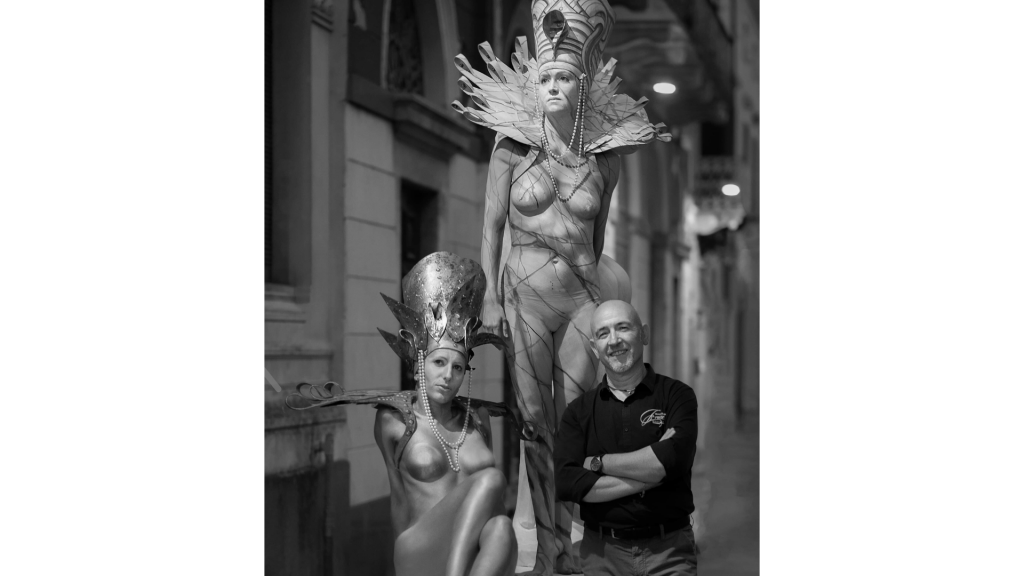
The “Living Marble Statues” project has taken Maurizio much further than he ever could have imagined: He has created many works for marble museums, art studios, and public events. It has also opened doors for him to international stages. ““There, I didn’t just present a performance—I presented a piece of my homeland by transforming the Italian sculptural tradition into a universal language.”
For him, however, the true innovation lay in creating a “new grammar of the body.” “I have left traditional painting behind to move toward installation art: Today, I no longer paint the model in isolation, but rather incorporate it into settings reminiscent of quarries, thereby creating a striking contrast between the body and raw materials.”
This would also have fundamentally changed his teaching style. Many came to him with the idea of hiding their true selves; Maurizio taught them to bring out their true selves.
“The human body is not a canvas; it is a partner. The difference between a decorator and an artist lies precisely in understanding that anatomy is a living architecture.”
Even in his role as a judge at body painting festivals such as “Deagu” in South Korea, he pays close attention to this: How does the paint react to movement? “If the model is stiff, it means the artist has confined the body and treated the skin like a wall. Art, on the other hand, is when the design seems to burst forth from beneath the skin, transforming the model into a living being.”
So transforming the body into marble does not mean, as one might first suppose, making it immobile, “but rather endowing it with that grandeur that only life can possess. Ultimately, the model’s soul is always the most important color on your palette.”
Looking Ahead
What’s next for Maurizio? Has he already reached his goals with his marble statues, or is the next project on the horizon? As someone who—by his own admission—is constantly searching for inspiration and thinking about how to improve his art, he has his sights set on two big dreams for the future:
For one thing , he wants to bring his art to the theater: “I want to bring a group of people onto the stage who, in the spotlight, transform into a living monument. Imagine seeing a block of stone that slowly takes shape, breathes, and begins to move. It would be a work that celebrates life, emerging from matter.”
The second is a return to the origins, “to the heart of the marble quarries. I would like to organize an intimate performance in the first light of dawn, when the light meets the pure white of the mountain. There, far away from everything, I would paint a living statue, using only natural pigments from the dust of this marble to create a dialogue between the skin and the rock.”
And what does Maurizio do when he’s not turning human bodies into marble?
“To recharge my batteries, I love going for walks in the mountains: Observing nature is my best lesson, because that’s where I find the answers I’m looking for. Then there’s the sea, especially at sunset. That’s a moment I love deeply: I savor its scent and ‘steal’ the colors of the light dancing on the water, trying to capture its essence to incorporate it into my next creations.”
We’re really looking forward to it and can hardly wait to see what works Maurizio will use to amaze us again soon.
Want to learn more about Maurizio?
Then why not visit his website or follow him on Instagram:

Be the first to comment