

From our Senjo Color practice as mentors on set: Without drama, but with a system.
If the airbrush could talk, it would tell you: “I don’t just spray paint on the model. I also spread paint dust around the room”
Don’t worry: you don’t have to train as a safety officer right now. You just need a quick check: face or body?
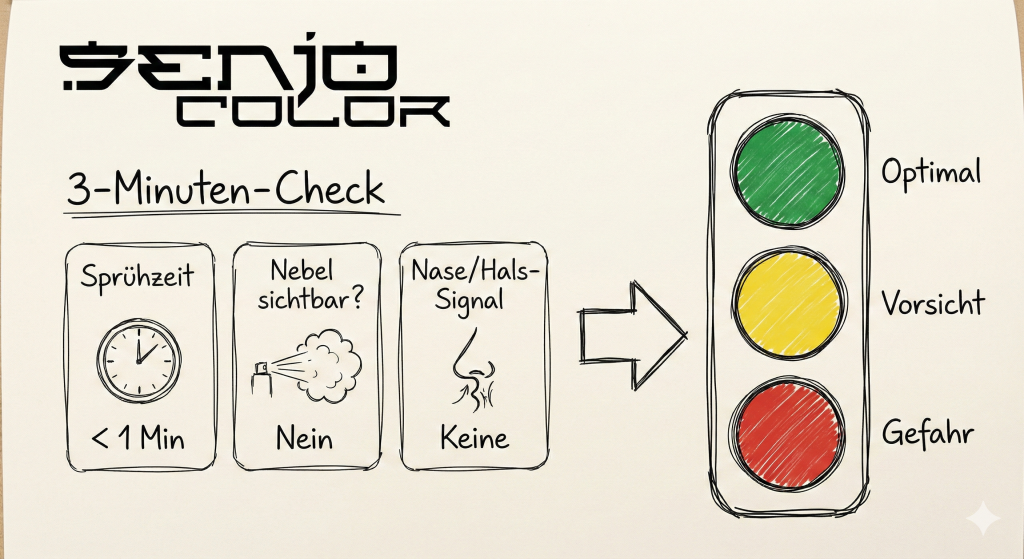
In 3 minutes you will know whether ventilation is enough, whether you should turn down the pressure or whether a mask phase is the more relaxed solution:
- Short spraying + good fresh air = often okay. Visible mist or scratching = improve setup.
- Face ≠ Body: Communication counts on the face, air plan + phases count on the body.
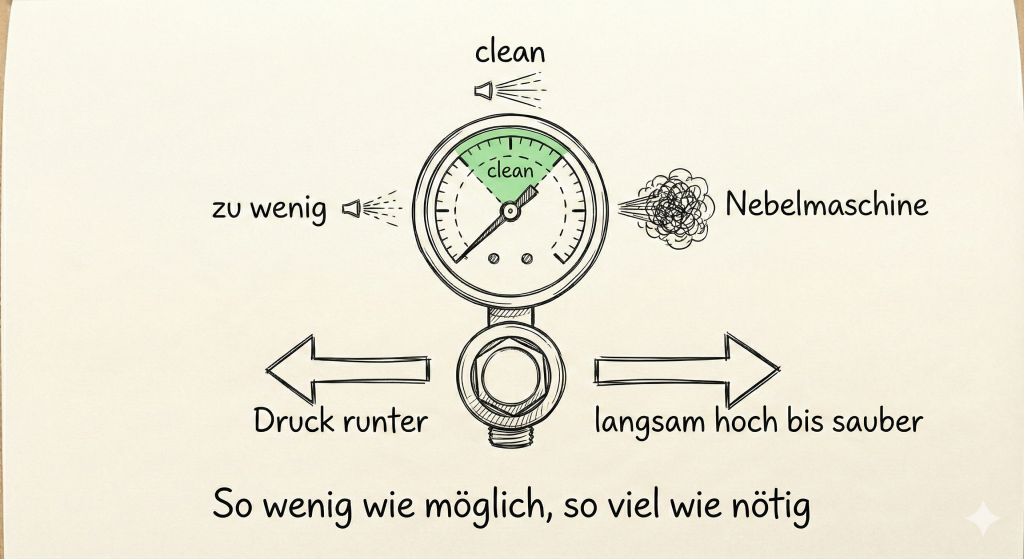
- Technique lever no. 1: Reduce pressure and increase slowly until enough paint comes clean → less overspray.
We don’t just produce the colors. We also know the subject from Senjo Color practice on set.
It’s not unnecessary fear that gets you further: it’s a set-up that works.
Contents
- Overspray in plain text
- The 3-minute check (3 questions)
- 1-screen setup checklist
- Traffic light 1: Face
- Traffic light 2: Body
- Professional routine: fresh air → mask → precision work
- 3 phrases that relax everything on set
- 5 classics that create unnecessary fog
- FAQ
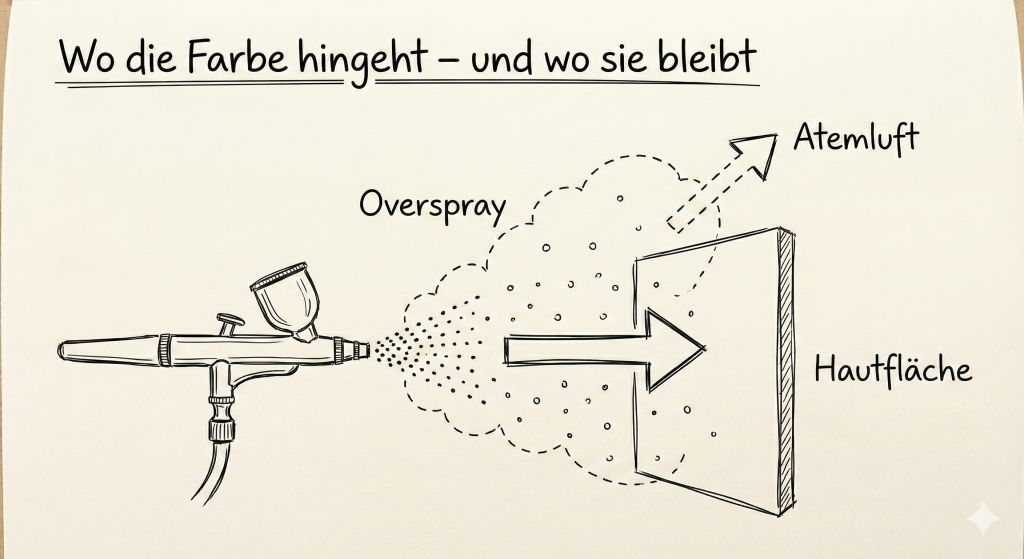
Overspray in plain language: The color itself is not the issue.
But the cloud of color that is created in the process
When airbrushing, not everything ends up where you want it. Some of it turns into a fine mist (overspray), remains in the air and can be quickly inhaled.
The good news is that you can control this very easily: with duration, air and technology.
The first thing you notice is your nose. And that’s your warning light.
You’re in the flow, everything is going well. And that’s why it often comes as a surprise: first you don’t notice anything, then your nose is dry. Maybe your throat scratches for a moment. Or you have this strange feeling as if something is “hanging in the air”.
That’s a pretty honest marker. Because overspray is not a theoretical problem. It is visible, noticeable and tends to collect where you need it least: in your breathing zone.
And the more often you spray, the smaller the room or the longer the session lasts, the more likely it is that “short” will become “too much”.
The 3-minute safety check: 3 questions, then you’ll know
Answer the questions honestly. No measuring device. No technical jargon. Just reality.
- Spraying time: Do you spray for longer than 10 minutes at a time or several people in a row?
- Fog: Do you see a cloud or does fog settle on surfaces?
- Body sensation: Is your throat/nose scratchy afterwards or does it feel “dusty”? Do you see any color residue in the nose / on the handkerchief?
Traffic light logic:
✅ 0-1× Yes = Green (ventilation + clean technology is usually sufficient)
⚠️ 2× Yes = Yellow (sharpen setup)
🛑 3× Yes = Red (ramp up protection)
1-screen setup checklist: Less fog, same opacity
This is the part you want to save:
- Reduce the pressure first. Then slowly increase until enough paint comes out clean.
Rule of thumb: As little pressure as possible, as much as necessary. - Check your position: Are you standing in your own spray cloud? → Work sideways, breathing zone clear.
- Intervals instead of continuous fogging: short sprays → pause → air change.
- Fresh air is part of the technology: not “afterwards”, but during the session.
- If fog remains visible: you are no longer in “green”. Then: air plan + mask phase if necessary
Why face and body are two different worlds
Now comes the most important thought:
Face and body are not “the same thing, just bigger”
In the face, you work close, precisely and in short moments. This means that the fog is often smaller – but it sits directly where you breathe. This is precisely why communication is so crucial here (breath announcement, short bursts, pause).
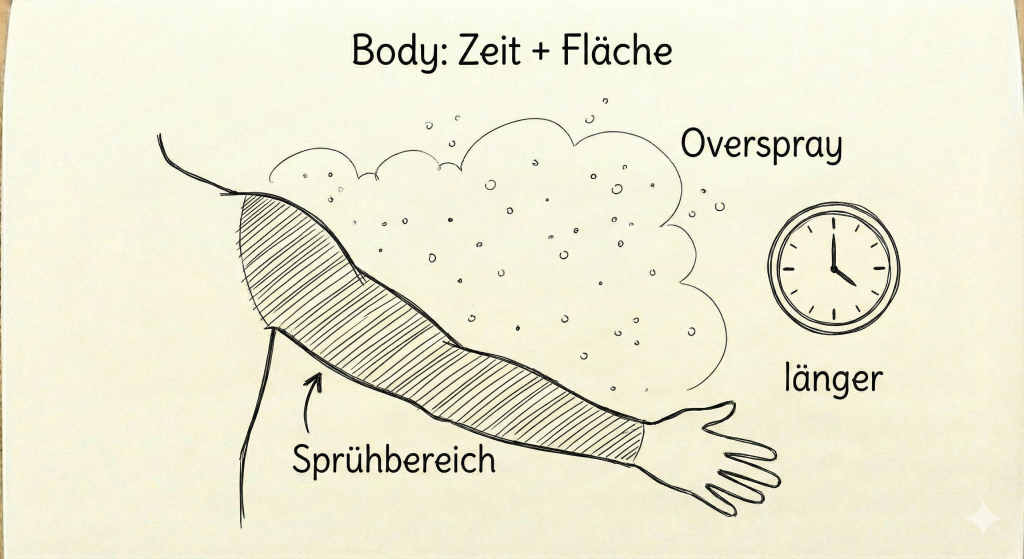
It’s often different with body painting: you’re not always so close to your mouth and nose, but you spray longer, more paint on more surface and often in several layers.
That makes the air the main subject.
In short: Face needs control at the moment. Body needs an off-air plan.
Traffic light check 1:
Face (close to the face)
On the face, the path to the air we breathe is short. There is no discussion here – the work is clean.
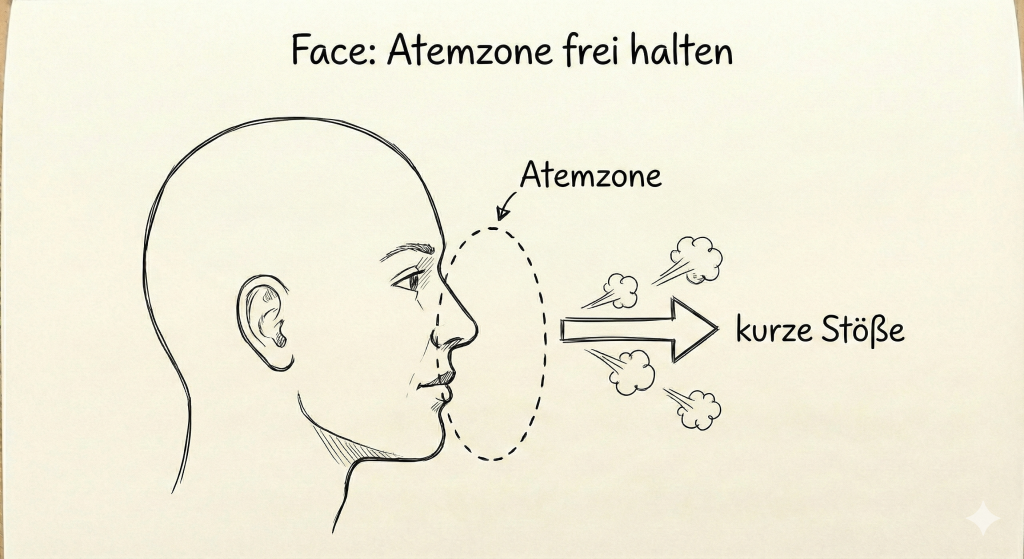
🟢 Green: announce briefly, spray briefly, done
If: short bursts, fog dissipates quickly.
Then:
- Stand sideways (do not spray into your breathing zone)
- Short bursts instead of continuous fog
- Set routine for the model:
“Hold your breath for a second … thanks, you can breathe again.”
🟡 Yellow: If you need longer, you need intervals
If: several layers, small space, fog hangs for a short time.
Then:
- ventilate during this time (not afterwards)
- Hold spray blocks briefly (2-5 seconds), then pause
- Technique lever: Pressure down → slowly up until it sprays cleanly
🔴 Red: If the cloud remains, protection becomes standard
If: visible cloud + stimulation or many models in a row.
Then:
- Mask for you (and for the model, depending on the situation)
- Air flow/extraction so that overspray draws away from you
- continue in short blocks + clear breathing announcement
Traffic light check 2:
Body (full body / large areas)
In bodypainting, it’s rarely the one spray that counts – it’s the sum. And the sum needs air.
🟢 Green: The air works with
If: outside / clear air vent / airbrush tent, fog draws off.
Then:
- Plan for a fixed air change
- Change position, do not stand in overspray
🟡 Yellow: Fog remains in the room – retighten setup
If: Overspray settles, room appears “milky”.
Then:
- Defined spray area / paint tent helps massively
- Continuous ventilation + plan air flow
- Pressure down → slowly increase until enough paint comes clean (mist sinks noticeably)
🔴 Red: Unavoidable? Then mask phase.
If: small room + long spraying time + mist remains visible.
Then:
- you and model mask, as long as large areas are sprayed
- Work in phases: Spraying phase (mask) → Airing → Fine work
- Precision work: a short breath announcement is often sufficient because the fog is smaller and dissipates more quickly
The professional routine: Fresh air first. Then mask if necessary. Then precision work.
Many people hesitate to wear masks because it feels “like drama” or because they are worried about unsettling the model. In practice, however, it’s often exactly the opposite:
A clear mask phase can even relax the process because you don’t have to constantly think about whether you are inhaling too much.
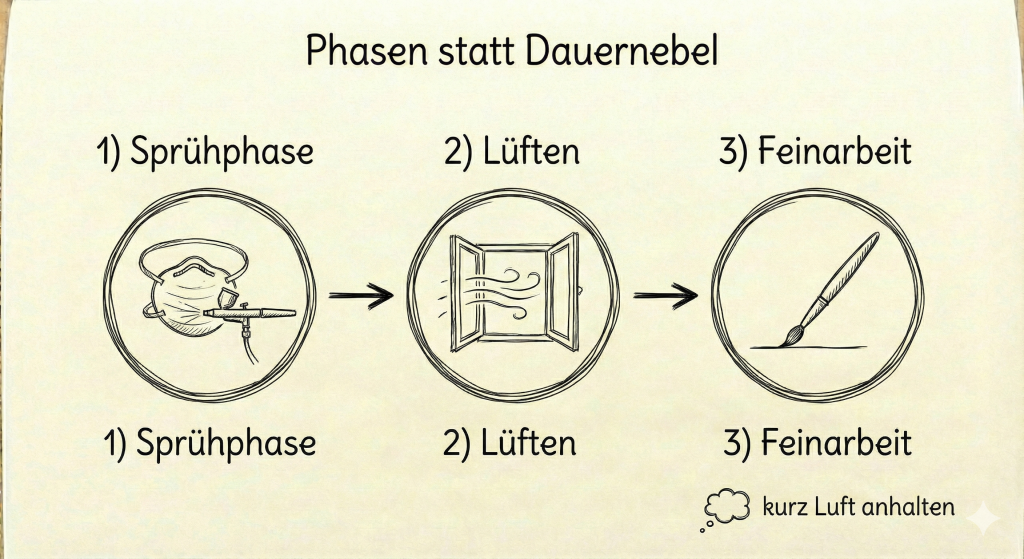
The logic behind this is important: Mask is not “forever”, but for the rough spraying phase, in which there is really a lot of overspray (large areas, long passages, small space).
As soon as you go into the fine work, i.e. short, precise bursts, the set routine with breath announcement and good air exchange is often sufficient. Just like when using hairspray.
This keeps things professional, calm and fast: intercept the spraying phase safely, then continue working freely.
If you only take one thing with you, take it in this order:
- Plan for fresh air (like tools – part of the job)
- Large areas = tent / outside / continuous ventilation
- If overspray cannot be avoided = mask phase (you + model)
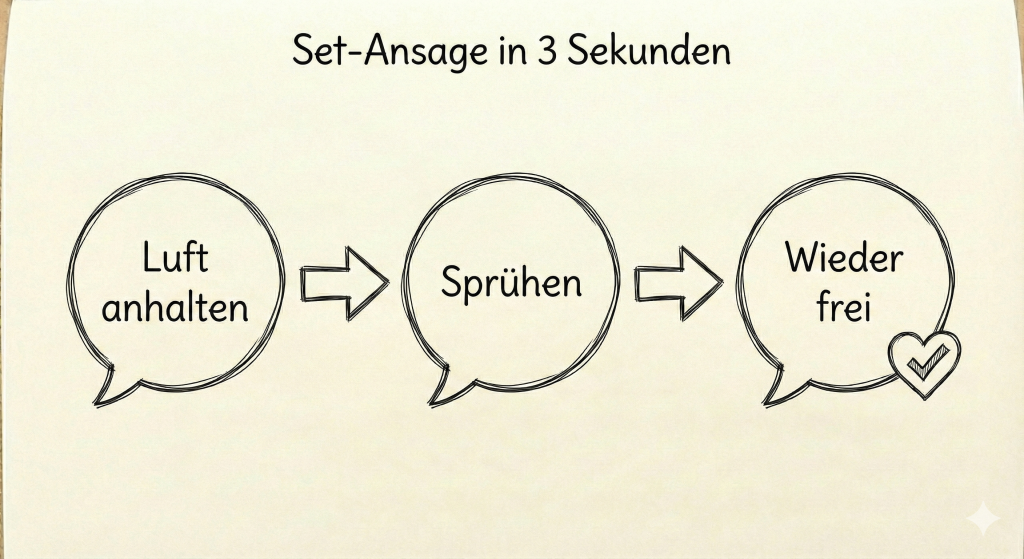
- Fine details = short breathing announcement: “Hold your breath … free again”
3 phrases to relax your model on set
- “Let’s put on a mask for a moment because of the paint mist.”
- “Please hold your breath briefly when spraying …”
- Don’t forget: “Thank you – you can breathe normally again.”
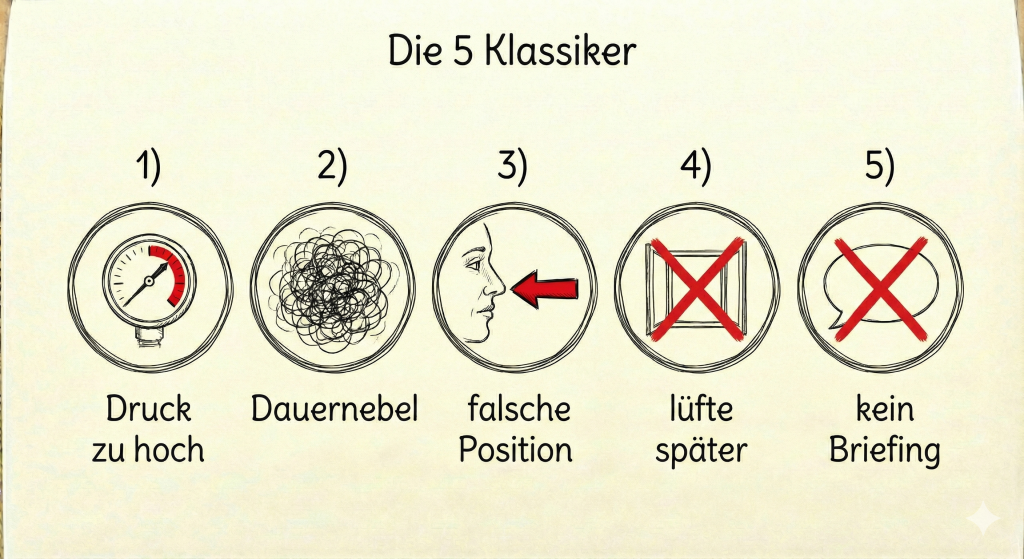
5 classics that create an unnecessary amount of color fog
- Pressure too high → reduce, slowly increase until it sprays cleanly
- Permanent fog → Intervals
- Incorrect position → Overspray in your own breathing zone
- “I’ll ventilate later” → ventilate in the meantime
- No briefing for the model → Coughing/twitching/stress
FAQ: Paint mist for airbrushing
Kaja from Senjo answers common customer questions.
Customer: Is airbrush paint mist dangerous?
Kaja von Senjo: Short and infrequent is usually uncritical – it becomes critical with a lot, often and without air exchange. If fog remains visible or your nose/throat reacts, this is a clear signal: improve the setup.
Customer: When is ventilation enough – and when do I need a mask?
Kaja von Senjo: Ventilation is often sufficient for short sprays and quickly dissipating mist. For small rooms, long sprays or visible clouds, a mask is the more relaxed routine.
Client: Should the model hold her breath while spraying her face?
Kaja von Senjo: Yes, briefly when spraying very close. Say it clearly and release immediately: “Hold your breath … thank you, you can breathe again.”
Client: As a make-up artist, should I also hold my breath?
Kaja von Senjo: This can help for individual short sprays, but is no substitute for a strategy. For longer passages, airflow, pressure and possibly a mask phase are the cleaner solution.
Client: Does the model have to wear a mask – and when?
Kaja von Senjo: This can be useful if there is a lot of overspray (body, long spray block, small room). For fine work, the breath announcement in short moments is often sufficient.
Customer: What helps most with body painting: outside, tent or ventilation?
Kaja von Senjo: The most important thing is that the fog must not remain in the room. Outside is often easiest, a color tent helps indoors and repeated airing should be part of the routine.
Customer: How can I tell that my setup signal is “red”?
Kaja von Senjo: If fog remains visible and/or nose/throat react, you are no longer in the green zone. Then raise the protection and change the air plan.
Client: How do I explain the mask without unsettling the model?
Kaja von Senjo: Talk about routine, not danger. A calm sentence is enough: “Mask because of paint mist. Standard with airbrushing.”
Conclusion: Working safely does not mean working more slowly
You don’t need a perfect world. You need a setup that keeps fog to a minimum – and a routine that you follow every time: plan the air, set the pressure correctly, work in phases, communicate well.
So airbrushing remains what it should be: precise, fast and pleasant.
Save the two traffic lights + the 1-screen checklist.
Briefly before each session: Face or body? Green, yellow or red?
Further information
- BAuA / TRGS 530 (hairdressing): Information on activities with sprays/aerosols and ventilation in the working environment
https://www.baua.de/DE/Angebote/Rechtstexte-und-Technische-Regeln/Regelwerk/TRGS/pdf/TRGS-530.pdf?__blob=publicationFile - DGUV dust information: Limit values (general dust limit value / A and E dust)
https://www.dguv.de/staub-info/rechtsgrundlagen/grenzwerte/index.jsp - Cosmetic Ingredient Review (CIR): Inhalation / Cosmetic Sprays (Documents & Updates)
https://www.cir-safety.org/sites/default/files/Inhalation_Admin_093024.pdf
Be the first to comment